01
Primary research direction
Personalised research into thinking
Development begins with understanding the individual precisely.
We study how a person perceives situations, directs attention, makes decisions and moves into action.
UpMan studies recurring patterns that shape personal development, partnerships and the way teams work.
Our ambition is to build one of the world’s most precise personalised systems for understanding and developing human thinking.
We study how a person perceives situations, directs attention, makes decisions and moves into action.
Using UpMan’s research methods, we create intelligent systems for specific people, roles and teams.
RESEARCH COMPETENCIES
We combine the study of neuro-somatic patterns, context and complex data to understand more precisely why the same visible behaviour may arise from different underlying mechanisms.
We study recurring connections between how a situation is perceived, where attention is directed, how the body responds and what action follows.
We model individual configurations and contexts, moving beyond an average profile towards hypotheses relevant to a specific person and situation.
We use AI to structure information, map hypotheses and identify complex relationships, while interpretation, verification and conclusions remain human.
APPLICATIONS OF OUR RESEARCH
Research hypotheses become the basis for personalised strategies for individual development, partnerships and team interaction.
The same words, decisions or actions may arise from different ways of perceiving a situation, directing attention and responding internally. UpMan helps narrow possible explanations to hypotheses that can be tested in the context of a specific person.
AI structures information, maps hypotheses and reveals connections that would be difficult to trace manually. The human determines what those connections mean, verifies them in a real context and remains responsible for the conclusions.
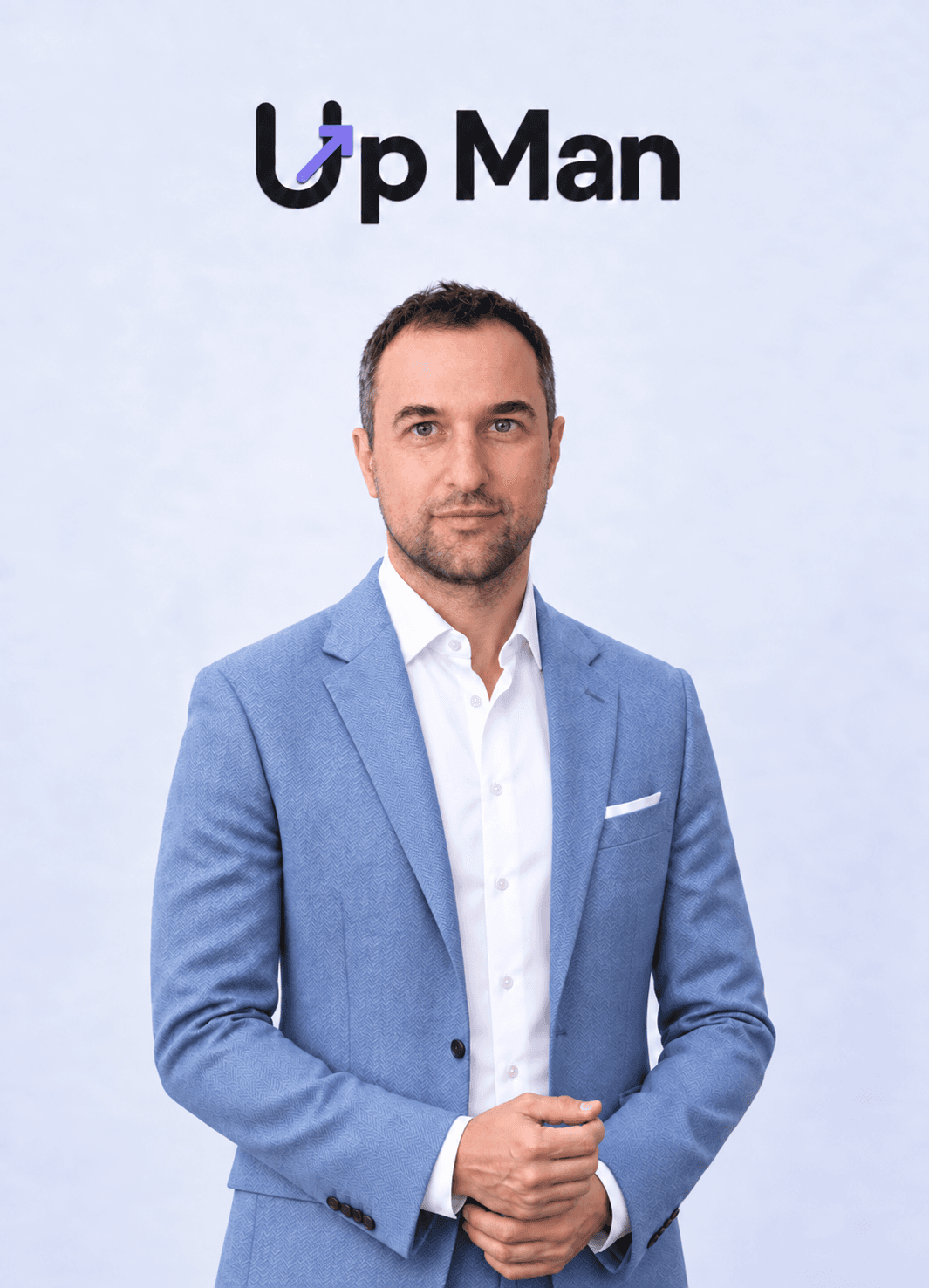
I study how people think, make decisions and interact, and I am developing UpMan’s personalised research architecture. My role is to shape the research approach, test hypotheses and remain responsible for the conclusions and their practical application.
Nearly two decades of practice across law, crisis consulting, property development, digital systems and human-potential development.